The Problem It Was Built to Solve
Walk into any classroom, any IT support desk, or any boardroom where someone is trying to make sense of a cloud migration proposal and you will find the same problem. Technology moves fast, and the language of technology moves even faster.
For students just entering the field, the alphabet soup of acronyms, API, DevOps, XSS, and LSTM can feel like a foreign language with no dictionary. For professionals switching careers into tech, the barrier is not intelligence; it is familiarity. And for organizations like DigiTech Edge Solutions that run AI literacy programs across Ghana, reaching students across multiple schools, the challenge is concrete: how do you make technical knowledge accessible, engaging, and self-directed?
That question is what gave birth to DigiLex.
What Is DigiLex?
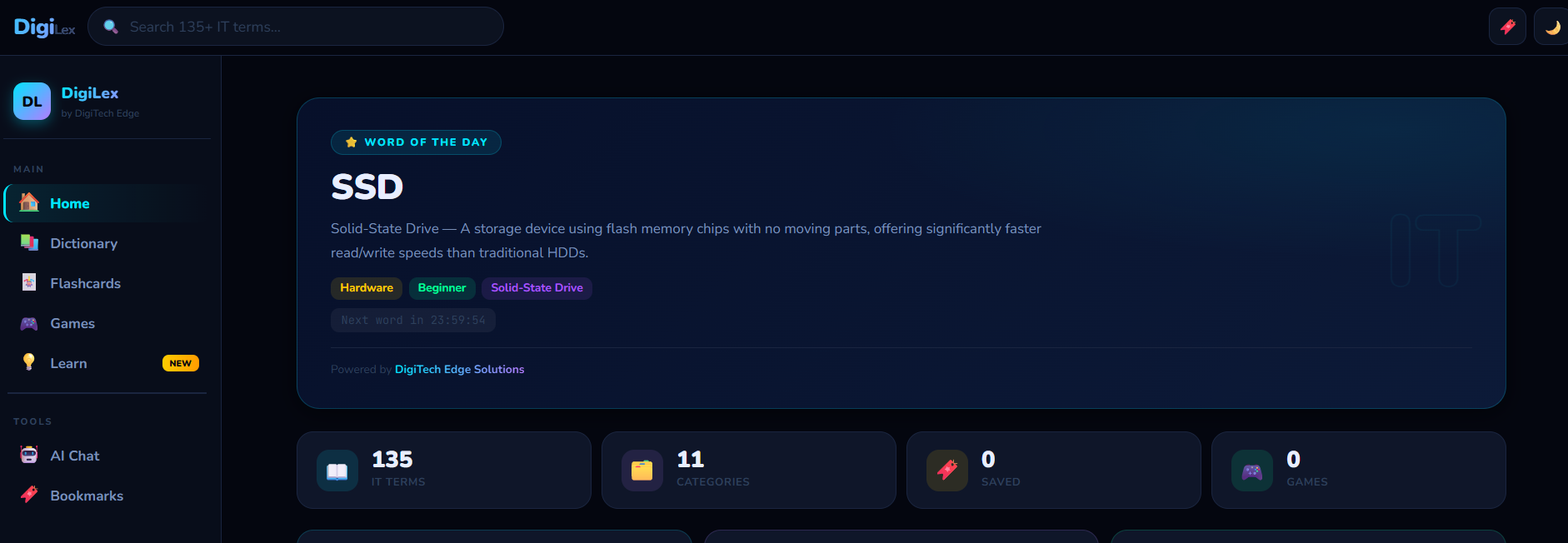
DigiLex is a free, browser-based IT dictionary and learning hub built and maintained by DigiTech Edge Solutions. It lives at digilex.digitechedge.org and requires no installation, no account, and no prior technical knowledge to use it.
At its core, DigiLex is a structured library of 135 IT terms spanning 11 categories from the fundamentals of networking and hardware to advanced territory in AI/ML, cloud computing, DevOps, and cybersecurity. Every term comes with a full definition, real-world examples, and, where relevant, acronym expansions.
But DigiLex is deliberately more than a glossary. It is a learning environment, one designed to take a curious non-technical person and progressively build their confidence through multiple modes of engagement.
Features at a Glance
📚 The Dictionary
The backbone of the platform. Users can browse all 135 terms or filter by category (Networking, Security, AI/ML, Cloud, Programming, Hardware, Databases, OS, Web, DevOps, and Basics) and by difficulty level (beginner, intermediate, or advanced). This tiered structure means a first-year student and a mid-career professional can both find their entry point without feeling overwhelmed or underwhelmed.
🃏 Flashcards
For learners who need active recall rather than passive reading, DigiLex offers a full flashcard study mode. Cards can be filtered by category and difficulty, shuffled for variety, and tracked so users know what they have mastered and what still needs work.
🎮 Games
Because Learning Should Be Fun
Five interactive games keep engagement high: Word Match, Memory, Quiz, Crossword, and Word Search. Each runs 10 rounds with difficulty that increases progressively. This gamified layer is particularly effective with younger learners — the same audience DigiTech Edge engages through its outreach events in Ghanaian schools.
💡 Learn to Code
An interactive coding module covering Python, JavaScript, HTML, CSS, and SQL. Learners work through structured lessons with a live code playground, progressing through an XP-based system with streak tracking. This module positions DigiLex not just as a reference tool but as a genuine entry point into software development.
🔖 Bookmarks & Word of the Day
Users can save terms they are studying for quick retrieval, and a daily "Word of the Day" feature introduces a new concept every day building vocabulary organically over time without requiring a dedicated study session.
The AI Feature: Your Personal IT Tutor
Perhaps the most powerful feature on DigiLex is the AI Chat, powered by Groq AI. This is not a generic chatbot. Positioned as an IT-focused assistant, it is available to answer questions about any concept in the dictionary, explain code snippets, compare technologies, and even offer career advice for people trying to break into the tech industry.
The Groq-powered backend means responses are near-instantaneous, a deliberate design choice, because learners lose momentum when they have to wait. Whether a student is trying to understand the difference between supervised and unsupervised learning or a professional needs a plain-English explanation of what a VPN actually does, the AI chat delivers answers that meet the user where they are.
This integration also future-proofs the platform. As DigiTech Edge expands its term library and learning modules, the AI layer can surface connections between concepts, suggest related terms, and adapt to each user's questions in real time, something no static dictionary can do.
Who Is DigiLex For?
DigiLex was built with three audiences in mind:
Students, particularly those in Ghana and across Africa who are gaining their first exposure to technology through school programs and who may not have access to expensive textbooks or paid learning platforms.
Career changers, professionals in non-technical fields who are moving into data, IT support, software, or digital transformation roles and need a reliable, jargon-free reference.
Teams and organizations and companies undergoing digital transformation who want to build baseline IT literacy across departments without formal training programs.
The platform is free, mobile-responsive, and works across devices, a deliberate accessibility choice that reflects DigiTech Edge's broader mission of democratizing technology education.
What Comes Next
DigiLex is actively evolving. The DigiTech Edge team is working toward expanding the term library beyond 135 entries, introducing more language options to serve non-English-speaking learners across West Africa, and deepening the AI capabilities, including personalized learning paths that adapt to what a user already knows and what they are working towards.
There are also plans to integrate DigiLex more formally into DigiTech Edge's school outreach curriculum, giving teachers and facilitators a structured digital tool to support AI and IT literacy sessions.
DigiLex is a new product with a clear and important purpose: to make the language of technology legible to everyone. In a world where digital literacy is increasingly a prerequisite for economic participation, tools like DigiLex are not just useful; they are necessary.
It is free. It is live. And it is only getting better.
Visit DigiLex at digilex.digitechedge.org
Digilex
DigiLex: Bridging the IT Knowledge Gap, One Term at a Time
In this article
Walk into any classroom, any IT support desk, or any boardroom where someone is trying to make sense of a cloud migration proposal and you will find the same problem. Technology moves fast, and the language of technology moves even faster.