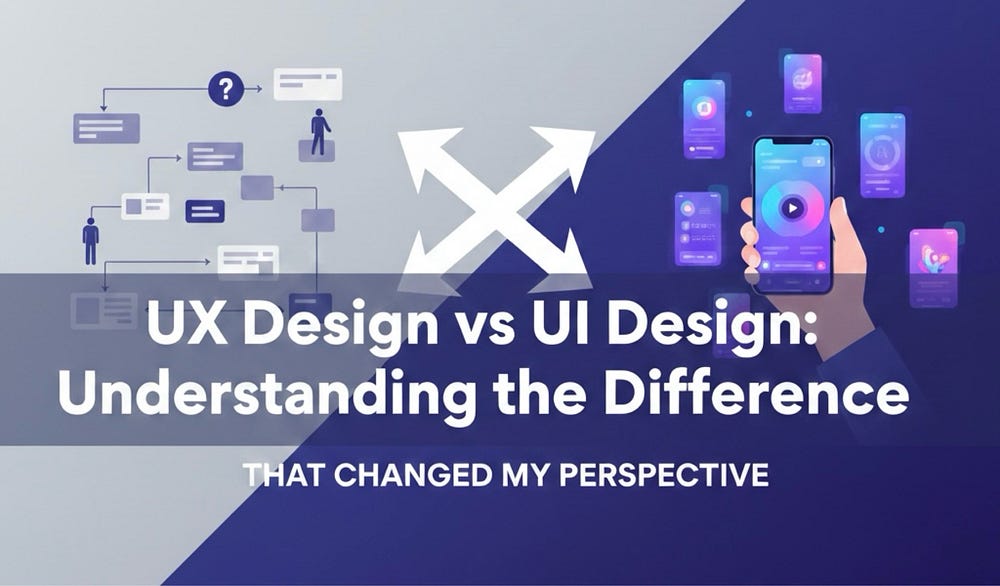
I’ll be honest — when I first heard people talking about “UX” and “UI,” I thought they were just fancy terms for the same thing. Both seemed to be about making apps and websites look good, right? Wrong. And understanding the real difference between them completely shifted how I approach digital products.
The Moment It Clicked
It happened during a conversation with a designer friend. I was showing off a beautifully designed app I’d found, going on about the sleek buttons and gorgeous color scheme. She smiled and asked, “But how does it feel to actually use it?”
That question stopped me in my tracks. I realized I’d been so caught up in how things looked that I hadn’t considered whether they actually worked well. That’s when she explained: UI is what you see; UX is what you feel.
The Restaurant Analogy That Made Sense
She gave me an analogy that stuck with me. Think of UI as the interior design of a restaurant — the lighting, the furniture, the plate presentation. It’s visual, it’s aesthetic, it sets the mood.
UX, on the other hand, is the entire dining experience. Can you easily find a table? Does the menu make sense? How long do you wait for your food? Do you leave satisfied? A restaurant can look absolutely stunning (great UI) but still frustrate you with terrible service and confusing menus (poor UX).
What UI Design Really Means
User Interface design is the craft of making things beautiful and visually coherent. It’s about:
1. Choosing the right colors that evoke the right emotions
2. Creating buttons and icons that are clear and clickable
3. Establishing typography that’s both readable and on-brand
4. Building visual hierarchies that guide your eye naturally
5. A UI designer is like a digital artist, painting the face of your product.
What UX Design Actually Involves
User Experience design is about the journey, not just the destination. It’s much broader and involves:
1. Understanding who your users are and what they need
2. Mapping out how people will move through your product
3. Testing whether your solutions actually solve real problems
4. Simplifying complex processes so anyone can navigate them
5. Asking “why” before asking “how”
A UX designer is part researcher, part psychologist, part strategist.
Why This Matters in Real Life
Once I understood this distinction, I started seeing examples everywhere. That banking app with the gorgeous interface that makes it nearly impossible to find your statement? Beautiful UI, terrible UX. That plain-looking note-taking app you use every day because it just works? Average UI, excellent UX.
The sweet spot? When both come together. Think of apps like Spotify or Airbnb — they look great and they make sense. You don’t have to think about how to use them; you just… do.
The Biggest Misconception
Here’s what trips up most beginners: thinking that making something “user-friendly” is just about making it pretty. I used to think that if I learned graphic design, I could create amazing digital products. But great design isn’t just about aesthetics — it’s about empathy.
You can have pixel-perfect buttons, but if users can’t figure out where to click, you’ve failed. Conversely, you can have a clear, logical flow, but if it looks like it was built in 2005, people won’t trust it enough to use it.
Where I Am Now
Understanding this difference changed how I evaluate every app I use, every website I visit. I’m no longer just impressed by pretty colors — I’m asking deeper questions. Does this make sense? Is this intuitive? Would my grandmother understand this?
More importantly, it’s changed what I want to learn. I realize now that before I worry about gradients and shadows, I need to understand people. What frustrates them? What delights them? What makes them abandon a checkout process halfway through?
The Bottom Line
UI and UX aren’t competing disciplines — they’re partners. One without the other is incomplete. The best digital experiences happen when visual beauty meets thoughtful functionality.
So if you’re starting your design journey like me, here’s my advice: learn both, but understand their distinct roles. Because at the end of the day, people might come for the beautiful interface, but they’ll stay for the experience that just works.
What’s your take on the UI vs UX debate? Have you had that “aha” moment where it all clicked? I’d love to hear about it in the comments.
UI/UX Design
UX Design vs UI Design: Understanding the Difference That Changed My Perspective
In this article
I’ll be honest — when I first heard people talking about “UX” and “UI,” I thought they were just fancy terms for the same thing. Both seemed to be about making apps and websites look good, right? Wrong. And understanding the real difference between them completely shifted how I approach digital...